
The guide · Part III · Chapter 11 of 14
Chapter 11 - When the Data Producer Is No Longer Human
From Clinical Meaning in the Age of Health Data & AI - a guide by Dr Balsam Khalil, MD. First edition, 2026.
Part III of four, chapter two of three. Chapter 10 established that a model inherits the record rather than repairing it. This chapter takes up what happens when the record is no longer written only by clinicians.
"When the clinical record has more than one author, what must it record about who wrote what - and what follows when it records nothing?"
The Clinical Problem
A woman comes in for a routine review of a long-standing condition. Halfway through, while the physician is examining her, she mentions that she stopped one of her tablets about three weeks ago because it was making her feel unwell. The physician hears it. She says something reassuring, keeps examining, and intends to come back to it before the end of the consultation.
The encounter is being recorded by an ambient documentation system. This category of tool - systems that listen to clinical conversations and write into the record without being explicitly prompted - is now widely deployed under the name Ambient AI. When it finishes, a note appears - fluent, well organised, correctly structured, in the physician's usual style. It describes the presenting concerns, the examination, the assessment and the plan. It reads like a note she would have written herself, which is the point of the system and also, as it turns out, the problem.
It does not mention that the patient stopped her medication.
She reads it. Not quickly - carefully, the way she reads everything she signs. And it matches her memory of the consultation in every respect she checks, because every sentence in it is true. Nothing has been invented. Nothing is wrong. She signs it.
Six weeks later a colleague, working from the medication list, adjusts a related drug on the assumption that the first is still being taken.
Now ask where the error was. Not in the note, which was accurate. Not in the physician's review, which was conscientious. Not in the colleague's reasoning, which followed the record as she found it. The system omitted something. What arrived in the record was an absence - and there is no visual signal for an absence. A note that looks complete gives the reviewer nothing to catch.
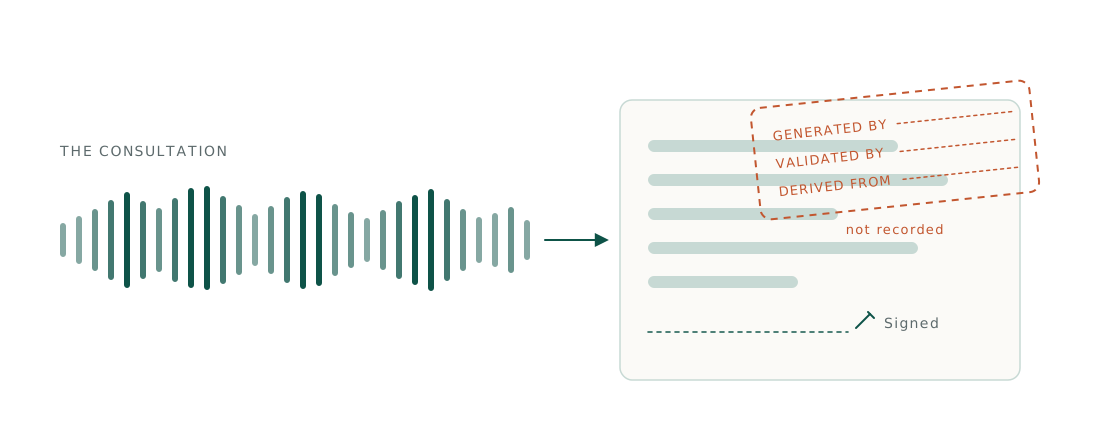
There is a second thing missing from that record. Nothing in it indicates that any part was generated rather than written. It carries one signature, as clinical notes always have, and that signature now certifies something different from what it certified five years ago.
What you should see differently - by the end of this chapter
- You should be able to separate three acts that used to be one - generating a clinical statement, judging it true, and taking responsibility for it.
- You should know what the evidence currently says about how AI-mediated documentation fails, and why the commonest failure is the one review cannot catch.
- You should understand how an unmarked record turns a tool problem into an individual clinician's error, case by case.
- You should be able to say what provenance has to record - and know that one part of the ecosystem has been recording it for decades.
- You should be able to hold two things at once: that these systems address a real and serious problem, and that the record they produce cannot currently be audited.
Chapter 11 · The second failure mode
The Hallucination: When the Record Contains What Was Never Said
"The omission is dangerous because it is invisible. The hallucination is dangerous because it is visible - and looks exactly like the truth."
The Clinical Problem - A Different Encounter, A Different Failure
A man of 54 comes in for a follow-up after a recent chest infection. The consultation is routine. He is recovering well. There is no mention of chest pain. No mention of breathlessness on exertion. The physician examines him, confirms improvement, and adjusts the antibiotic course. The encounter runs twelve minutes.
The Ambient AI system generates the note. It is fluent, well-structured, and reads exactly as the physician would have written it. She reviews it before signing - carefully, as she always does.
The note contains the following sentence: "Patient reports mild exertional dyspnoea, improving since last visit."
He said no such thing. There was no last visit in which dyspnoea was discussed. The system generated a clinically plausible sentence - the kind of sentence that belongs in a note for a man of 54 recovering from a chest infection - and inserted it as fact.
She reads it. It is coherent. It fits the clinical picture. It does not contradict anything she remembers. She signs it.
Three months later, a cardiologist reviewing the record for an unrelated reason sees a documented history of exertional dyspnoea. She investigates accordingly.
Now ask where the error entered. Not in the physician's review, which was careful. Not in the cardiologist's reasoning, which followed the record as written. The system generated a statement with no clinical origin - and the record gave it the same weight as every other statement the physician had ever written. There is no marking to distinguish what was said from what was inferred. There is no signal that any sentence in the note was generated rather than transcribed.
This is the hallucination in clinical documentation. It is not a dramatic invention. It is a plausible sentence, in the right style, about the right kind of patient, inserted into a record that will be read - and acted upon - by clinicians who have no way of knowing it was never said.
Omission and Hallucination - Two Failure Modes, One Unauditable Record
Omission
- Something said is not recorded
- The record looks complete
- The absence has no visual signal
- Detected only by the person who was in the room
Hallucination
- Something not said is recorded
- The record looks accurate
- The presence reads as fact
- Undetectable without the original audio
Both failure modes share one property: neither can be identified by reading the note. The only way to audit either is to compare the record against the original encounter - which, in most deployments, is not retained, not accessible, and not required.
Chapter 11 · Scientific foundation
The Scientific Foundation: Three Acts, One Signature
The Problem Is Solved. It Is Not Adopted.
The imaging layer records who or what made an observation, and what that observation was derived from. Its structured reporting model carries observation context including the observer's identity. All of this is decades old.
So the layer clinicians think of as just the pictures has been doing provenance since long before anyone was anxious about generated text. The mechanisms exist. They have existed for years.
Which means the seventh modifier is not an unsolved technical problem but an unadopted one - and that distinction moves the question from can this be done to why has our institution not done it.
Three Acts That Used to Be One
For as long as there have been clinical records, writing a note involved three things happening together. Somebody composed the statement. Somebody judged it to be true. Somebody took responsibility for it. They were the same person, doing all three in one motion, and the record represented that with a single signature. There was never any need to distinguish them, because they were never separable.
They are separable now, and in a great deal of practice they have already been separated. A model generates. A clinician validates. The same clinician attests. The record still holds one signature.
A signature that once meant I wrote this and I stand behind it now means, variably and without disclosure, either that or I read this and did not object to it. Those are different acts. They produce different reliability. And the record does not distinguish between them.
What the Evidence Says
The benefits are real. Studies consistently report reduced documentation burden, less cognitive load, better clinician satisfaction, and more attention on the patient during the encounter. Reductions in measured burnout have been demonstrated in trial conditions. These findings address a serious problem and should not be waved past.
Omission is the commonest error. In a prospective pilot in which physicians evaluated a sample of generated notes, accidental omissions occurred in roughly 18% - more often than hallucinations at around 11.5%, and more often than accidental inclusions.
Three studies, three directions. A vendor-affiliated evaluation found hallucinations in 31% of ambient notes and 20% of physician-authored ones, with reviewers preferring the ambient notes overall. An independent evaluation from a veterans' health system found the opposite: eleven scribe tools against eighteen human note takers, and the human notes scored higher in every clinical scenario tested. A third study, comparing against handwritten notes in South Africa, found the reverse again.
They are not contradicting each other. They are comparing against different baselines - and the baseline turns out to determine the answer.
The fair question is not whether the tool is perfect but how its errors differ from ours - in kind, and in whether anyone can catch them. Our errors are ours to catch. A generated omission is invisible to the person asked to catch it.
Why Omission Is the Failure This Guide Predicted
A generated note is fluent and internally coherent by construction. Its errors of commission are visible, because a reviewer can read a false statement and recognise it as false. Its errors of omission are invisible, because there is nothing on the page to read. A blank page forces reconstruction. A complete draft does not.
Two Failures, One Gap
Sometimes the system leaves the thing out. Sometimes it puts something plausible in its place. Omission and fabrication are two behaviours of one underlying event - what happens when the system does not hear or understand something. Which one you get depends on where the gap fell rather than on anything a clinician did or could have influenced.
Fabrication is the slower problem. An omission may eventually be noticed. A plausible sentence that was never said will sit in the record permanently, because nothing about it invites a second look.
The Seventh Modifier
All of this returns to the modifier Chapter 3 deferred and Chapter 7 introduced. In DICOM it appeared as an established mechanism, already in place and already unused. Here it appears as the property whose absence makes the failures above unauditable - the same modifier, met at the point where doing without it stops being an omission and becomes a liability.
"Provenance. For any clinical statement: what generated it, who validated it, what it was derived from, and when each of those happened. Four elements. All four are representable today, in standards that exist and are in use. None of them is routinely recorded for generated clinical text."
Chapter 11 · Clinical perspective & questions
The Physician's Apparatus: Review, Signature, and Governance
We Do Not Review a Good Draft the Way We Review a Blank Page
A blank page forces you to reconstruct. You retrieve the encounter from memory and build it, piece by piece, and the building is itself a check - you notice what is missing because you are the one putting it there. A fluent draft that matches your recollection asks something else of you entirely. You read for anything that contradicts what you remember. That is confirmation, and it is a different cognitive task, done faster, with a different error profile. None of that is carelessness. It is what competent people do with a competent draft. Which is why the quality of the draft is not straightforwardly protective. A worse draft would be reviewed more carefully.
The Signature
The signature has not changed. What it certifies has. A physician signing a generated note is attesting to a document she did not compose, whose omissions she has no reliable way of detecting, produced by a system whose failure modes she has not been shown, leaving no trace of its involvement in the record she is signing.
That is not an argument against these tools. The burden they address is real, and clinicians who feel relief from it are not being naive. It is an argument that the terms are currently one-sided, and that the missing piece - a record of what was generated and what was validated - is the thing that would make them fair to the clinician as well as useful to the institution. This belongs with professional bodies and clinical governance. It is not something an individual clinician should have to negotiate at the moment of signing.
A Clinical Observation About Timing
Review of a generated note is not one task. It is two, and which one you are doing depends entirely on when you do it. Read the note within a minute or two of the patient leaving, and you are comparing it against a live memory of what happened. In that state an omission is perceptible. Read the same note four hours later, at the end of a clinic, and the memory has gone. All you have is the text, which is the very thing you were supposed to be checking.
These systems save time. The obvious thing to do with saved time is see more patients. My view is that the first use of that time should be immediate review of the note just generated. A clinic that absorbs the entire saving into throughput has adopted the tool and discarded the condition that made it defensible.
The Governance Case - Without Provenance, Every AI Error Becomes the Clinician's
An institution deploys ambient documentation across its ambulatory services. Two years later there is a patient safety review. A relevant clinical detail was missing from a note written eighteen months earlier. The review asks one question: was that omission the physician's, or the system's? It cannot be answered. Not because records were lost - because the distinction was never recorded in the first place.
"Without provenance, every AI-mediated error is attributed to the clinician who signed it. A systems problem gets converted, case by case, into individual error - and the pattern that would have identified it as systemic is never assembled."
One question for your institution
If that review happened at your organisation next month, could you answer it? And if not, who decided that you would not be able to?
Six Questions to Ask
- Does our record distinguish generated text from physician-authored text? If not, who decided that, and when is it being revisited?
- Is the generated draft retained, and can a reviewer see what was changed before signing?
- What are this system's measured omission and fabrication rates in our specialty and our patient population - not the vendor's published figures?
- Has its performance been assessed across the languages, accents and speech patterns of our actual patients?
- If a safety review needed to establish whether an omission was generated or physician-made, could we answer?
- Who is accountable when a systematic omission pattern is found - the clinician, the institution, or the supplier? Is that written down anywhere?
Question 5 is the one to ask in a governance meeting. It takes a sentence, it is concrete, and the answer is almost always no.
What to Reconsider
Think of the last note you signed that you did not compose from a blank page. You read it, found nothing wrong, and signed. Consider what your signature has always meant: that you were present, that you read it, that you agree with it, and that you produced it. Those four have travelled together for as long as clinical records have existed, and on that occasion they came apart without anything marking the separation. You have been signing one thing and being read as having signed another.